

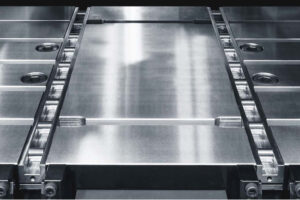
Die lifters are rails that sit in the bolster slots and lift the die slightly on rollers, so it can be pushed into position with little force and then clamped. They are what make die carts, bolster extensions and pre-rollers work.
Shop Die LiftersRequest a QuoteCall (800) 863-3164How They Work · Types · At a Glance · Choosing · What We Need · FAQs
How Die Lifters Work
Die lifters are available as spring, air (pneumatic) or hydraulic types. They mount in the T-slots or U-slots of the bolster and reduce the effort needed to move and locate a die. A sub-plate under the lower die is required so the die can ride on the rollers.
Hydraulic lifters use a cylinder in the rail to lift the die off the bolster; Pascal's DLF lifts 3 to 4 mm as standard. Spring lifters hold the die up with springs and are pressed back down into the bolster by the clamping force, so you clamp against the lifter force. Pneumatic lifters raise the die on rollers using shop air.
Roller lifters guide the die in a straight line along the slot. Ball-type lifters, another design on the market, let a die move in any direction for alignment. Pascal's DLF and DRA lifters are roller types.
Die Lifter Types
Pascal Die Lifters at a Glance
| DLF hydraulic | DRA spring | |
|---|---|---|
| Lift | 3 mm (DLF28, DLF50) or 4 mm (DLF80) standard; long-stroke versions to 16–20 mm | 2 mm max. |
| Load | 0.98 / 1.86 / 5 kN per roller (about 220 / 418 / 1,124 lbf); up to 160 kN (about 36,000 lbf) per 2 m heavy-load DLF80 rail | 0.588 / 0.735 / 1.47 kN lifting force per 100 mm (about 132 / 165 / 330 lbf), DRA18 / DRA20 / DRA30 |
| Mounting | Bolster slot machined to suit the lifter | Existing T-slots or U-slots, 18–36 mm wide |
| Power | Hydraulic, 24.5 MPa (about 3,550 psi), from a Pascal control unit | None |
| Temperature | 0–70°C; heat-proof type 5–120°C | 0–110°C |
| Options | Scrap-hole types, roller cover, long stroke, heat-proof | Sizes to fit standard slots |
From Pascal’s published DLF and DRA catalogs. Confirm current ratings with PRI when you quote.
How to Choose Die Lifters
- 1Die weight and footprintHeavier and larger dies need more rails or a higher-rated rail. Pascal rates the DLF per rail and assumes every roller is in contact with the die, so the sub-plate has to cover the rails.
- 2Slot type and sizeSpring DRA lifters drop into existing T-slots or U-slots 18 to 36 mm wide; hydraulic DLF lifters need the slot machined to suit.
- 3Power at the pressSpring lifters need no power. Hydraulic lifters run from a hydraulic control unit; pneumatic lifters run on shop air.
- 4Lift heightStandard lifts are a few millimeters. Long-stroke versions give more clearance where the die or sub-plate needs it.
- 5ClampingSpring lifters are pushed down by the clamping force, so the clamps have to overcome them. Plan lifters and clamps together.
- 6Heat and scrapCheck the operating temperature at the bolster, and use scrap-hole versions and roller covers where slugs fall through the bolster.
A bolster drawing answers most of these:
- Bolster drawing: slot type, width, depth and spacing
- Scrap holes and their locations
- Die weights and footprints
- Sub-plates or parallels in use
- Which side dies enter from
- Press make, model and tonnage
- Hydraulic or air supply available
- How dies reach the press (cart, forklift, pre-rollers)
Die Lifter Brands PRI Offers


Die Lifter Downloads
Frequently Asked Questions
Do I need sub-plates to use die lifters?
Yes. A sub-plate under the lower die is required so the die can ride on the lifter rollers.
Should I use spring or hydraulic die lifters?
Spring lifters need no power, fit existing slots and suit small to mid-sized dies, but they push back against the clamps. Hydraulic lifters use a cylinder in the rail to lift heavier dies and run from a hydraulic control unit.
How much can die lifters carry?
It depends on the model and rail length. Pascal's DLF hydraulic lifters are rated up to about 36,000 lbf per rail (2 m heavy-load DLF80). Pascal's DRA spring lifters provide about 132 to 330 lbf of lifting force per 100 mm of rail. Green Valley pneumatic lifters carry 750 or 1,000 lb per foot at 80 psi.
Will die lifters fit my existing T-slots?
Pascal's DRA spring lifters fit existing T-slots and U-slots 18 to 36 mm wide. Pascal's DLF hydraulic lifters need the slot machined to suit. Send PRI your bolster drawing and we'll check the fit.
How do I get the die onto the lifters?
With bolster extensions or pre-rollers at the front or back of the press, or with a die cart. Pascal says one person can load and unload dies up to 8 tons with its pre-roller stand.
Related Guides
Quick Die Change · Bolster Extensions · Die Carts · Die Clamps · Die Storage Racks
Send us your bolster drawing and die weights. PRI will recommend the lifters and quote them.
Shop Die LiftersRequest a QuoteCall (800) 863-3164