


Die clamps lock the upper die to the slide and the lower die to the bolster. Quick die change clamps do it in seconds from a control, with no bolts to run down by hand inside the die space.
Shop Die ClampsRequest a QuoteCall (800) 863-3164How Clamping Works · Clamp Types · At a Glance · Power & Interlocks · Choosing · What We Need · FAQs
How Quick Die Change Clamping Works
OSHA 1910.217(d)(7) calls for provision in both the upper and lower die shoes for securely mounting the die to the bolster and slide. Bolting each die by hand is slow and inconsistent. Quick die change clamps sit in the T-slots of the bolster and slide, reach over the die's clamping edge, usually through a U-cut in the die shoe, and clamp it with a hydraulic cylinder.
Common clamping heights and locations are necessary to properly implement QDC clamping. When every die has the same clamping edge thickness and its U-cuts in the same places, the clamps go to the same spots for every die and the change is repeatable. See the quick die change guide for how standardizing dies fits into the whole changeover.
Mechanical clamps need no power supply, but each one is tightened by hand. Hydraulic clamping systems are the preferred choice for a complete QDC system with hydraulic die lifters: one control unit clamps or unclamps every clamp at a switch, and sensors can confirm each clamp is in position.
Die Clamp Types


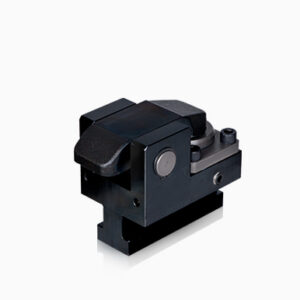
Pascal Die Clamps at a Glance
| How it reaches the die | Clamping force | Notes | |
|---|---|---|---|
| TXA cylinder | Slid by hand in the T-slot | 9.8–245 kN (about 2,200–55,000 lbf), 7 sizes | Hydraulic, 24.5 MPa (about 3,550 psi); 0–70°C, heat-proof type 5–120°C |
| TYA lever | Slid by hand in the T-slot | 9.8–245 kN, 7 sizes | Hydraulic, 24.5 MPa; lever arm |
| TXC / TYC | Air cylinder slides it to the die | By clamp size | Automatic slide versions of TXA and TYA |
| TR traveling | Chain drive in the T-slot: TRA air cylinder, 400–1,300 mm travel; TRC electric motor, 400–900 mm | 39.2 / 61.7 / 98.0 kN (about 8,800 / 13,900 / 22,000 lbf) | Die detection and backward-end switches; replaces common plates |
| TRX traveling | Electric motor, 200 or 300 mm travel | 39.2 or 61.7 kN | Compact, vibration-resistant; −10 to 50°C |
| Press mag clamp | Magnetic plate, no clamps to move | Permanent magnets; power only to switch on and off |
From Pascal’s published TX, TY, TR and TRX catalogs. Confirm current ratings with PRI when you quote.
Power, Sensors and Interlocks
Hydraulic clamps run from a Pascal control unit. Its Pascal pump is an air-driven hydraulic pump: shop air drives it, it stops once the circuit reaches set pressure and uses no air while holding it, and it starts again on its own if pressure drops. Separate circuits handle the upper clamps, the lower clamps and the die lifters, so the operator clamps or unclamps the die from a switch.
An optional die detection switch on the clamp prevents a misplaced clamp. With a Pascal operation and control panel, clamp sensors form an interlock that will not let the operator proceed until the proper steps have been taken. Plan clamps and lifters together: spring die lifters push back against the clamping force.
How to Choose Die Clamps
- 1Standardize the clamping edgeSettle on a common clamping edge thickness and U-cut pattern for your dies, or list each die's. Pascal sizes each clamp to the T-slot and the die thickness.
- 2Measure the T-slotsSend T-slot sizes and locations for the bolster and the slide. On existing presses Pascal asks for the T-slot and die thickness dimensions to 0.1 mm.
- 3Size the clamping forceClamp size comes from the die, the press and the work. PRI sizes the clamps with Pascal from your press and die data.
- 4Choose how clamps reach the dieManual slide clamps where operators can reach every clamp easily, automatic slide clamps where they can't, and traveling clamps on the slide of large presses or to eliminate common plates.
- 5Check heat at the dieStandard clamps run from 0 to 70°C; heat-proof versions run to 120°C for hot dies and surroundings.
- 6Plan power and interlocksChoose the control unit, die detection switches and how clamp status ties into the press control.
A bolster and slide drawing answers most of these:
- Press make, model and tonnage
- Bolster and slide drawings with T-slot sizes and locations
- Die clamping edge thickness, U-cut locations and widths
- Die weights and sizes (smallest and largest)
- Upper clamps, lower clamps or both
- Manual slide, automatic slide or traveling
- Operating temperature at the die
- Shop air, electrical supply and press control make
- Die lifters in use or planned
Die Clamp Brands PRI Offers

Mold clamps for injection molding machines, also from Pascal, are covered in our quick mold change guide and the injection molding auxiliary equipment catalog.
Help From PRI
PRI's Application Engineers review your bolster and slide drawings and die list, recommend clamp types, sizes and positions, and lay out the control unit and interlocks. PRI coordinates installation and training with Pascal and supports the clamps afterward. While dies are being adjusted or repaired in the press, OSHA 1910.217(d)(9)(iv) calls for safety blocks; PRI supplies safety blocks and press safety surveys (see PRI services).
Die Clamp Downloads
Frequently Asked Questions
What types of die clamps are used for quick die change?
Hydraulic T-slot clamps (cylinder or lever type) that slide to the die by hand or automatically, traveling clamps that move through the T-slots to the die on their own, fixed clamps for lower dies on common sub-plates, and magnetic clamps. Common clamping heights and locations are necessary to properly implement QDC clamping systems.
Should I use hydraulic or mechanical die clamps for quick die change?
Quick-acting mechanical clamps are a step up from conventional bolts and make it faster to fasten tools in place, but each is tightened by hand. Hydraulic clamping systems are the preferred choice for a complete QDC system with hydraulic die lifters: every clamp works from one switch, and sensors can confirm each one is in position.
How do hydraulic traveling die clamps work?
On Pascal's TR series, a chain drives the hydraulic clamp through the T-slot toward the die. A die detection proximity switch stops it at the die and it clamps hydraulically. When unclamped it returns to its home position, where it is held rigidly so it doesn't vibrate with press operation. The drive is an air cylinder (TRA) or an electric motor (TRC).
Can quick die change clamps be added to an existing press?
Usually. Pascal T-slot clamps are sized to your existing T-slots and die thickness, and Pascal says its TR traveling clamps can be easily retrofitted on existing presses. Send PRI your bolster and slide drawings to check the fit.
Can a magnetic clamp be used on a stamping press?
Yes. Pascal says its magnetic clamp also works on metal stamping presses, high speed presses and die casting machines. The magnets are permanent: energy is needed only to switch on and off, and the clamp stays magnetized during a power outage.
Do you offer clamps for injection molding machines?
Yes. Pascal hydraulic, air and magnetic mold clamps are in the quick mold change section of the PRI catalog, under Injection Molding Auxiliary Equipment.
Related Guides
Quick Die Change · Die Lifters · Bolster Extensions · Die Carts · Die Storage Racks & Tables · Quick Mold Change (injection molding)
Send us your bolster and slide drawings and die list. PRI will recommend the clamps and controls and quote them.
Shop Die ClampsRequest a QuoteCall (800) 863-3164