


A stock cutter is a compact shear for coil stock, strip and wire. Mounted at the end of a progressive die and timed to the press, it works as a scrap chopper, cutting the skeleton into short pieces. Paired with a feed, it cuts stock to length. PRI supplies Rapid-Air pneumatic cutters.
Shop Scrap ChoppersRequest a QuoteCall (800) 863-3164What They Do · How They Work · Types · Choosing · What We Need · Brands · FAQs
Scrap Choppers vs. Stock Cutters
They are the same kind of machine doing two jobs. As a scrap chopper, the cutter sits at the end of a progressive die or similar process and cuts the coil stock or skeleton scrap leaving the die into short pieces. Chopped scrap drops into a hopper or onto a scrap conveyor instead of piling up at the press, which makes it easier to handle and helps you recapture its value.
As a stock cutter, it cuts strip, flat stock or wire to length. Rapid-Air offers a full range of pneumatic cutters for routine or specialty shearing and cut-to-length jobs. A cutter can be a stand-alone press, a base-mounted unit, or part of a fully synchronized cut-to-length system, and it can be integrated with existing equipment to complete a cut-to-length or cut-off operation. For complete lines, see the cut-to-length guide.
How They Work
Rapid-Air cutters are pneumatic: they run on shop air, with force ratings given at 100 psi. They are electrically actuated and timed to the press or machine cycle by a rotary limit switch, a programmable limit switch or a similar device, such as the ProCamPAC programmable limit switch in a Wintriss SmartPAC PRO. A proximity switch can be fitted to indicate when each cut is complete.
Two blade designs cover the range. Pivoting-arm cutters swing the blade through the stock, for light-gauge flat stock and for round stock. Reciprocating-blade cutters drive the blade straight across flat stock up to 24" wide.
Heavier cutting calls for a hydraulic shear. PRI supplies those as part of Press Room Equipment (PRE) cut-to-length machines, which mount PRE air or servo feeds to pneumatic or hydraulic shear stations. See the cut-to-length guide.
Rapid-Air Cutter Types
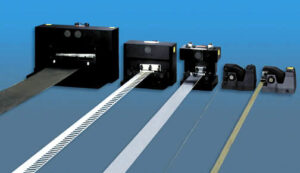
Rapid-Air bases these cut ranges on low-carbon, commercial-grade steel. Tell us the material and its strength so we can check the cutter against it. Model-by-model ratings and blade openings are on the Rapid-Air cutter product page.
How to Choose a Scrap Chopper or Stock Cutter
- 1Stock shape and sizeFlat or round; the widest stock or largest diameter, the thickness, and the material and its strength.
- 2The jobChopping skeleton or strip scrap at the die, cutting off parts, or cutting stock to length with a feed.
- 3MountingStand-alone press, base-mounted at the die exit, or built into a cut-to-length system. Check the space at the end of the die and the passline height.
- 4Timing and speedHow the cut will be timed (rotary or programmable limit switch) and how many cuts per minute the press or feed needs. Add a proximity switch if the control should confirm each cut.
- 5Where the scrap goesPlan the hopper or the scrap conveyor under the cutter. See the conveyor guide and shaker conveyors.
- 6Air and guardingRatings are at 100 psi shop air. The cutter blade is a point of operation, so plan its guarding with the rest of the press; see press safeguarding.
Send what you have:
- Material type, width and thickness (or diameter)
- Tensile or yield strength
- Scrap chopping, cut-off or cut-to-length
- Cut length and cuts per minute
- The press or feed and its control
- Timing device available (rotary or programmable limit switch)
- Mounting: stand-alone, base or CTL system
- Available air pressure
Cutter Brands PRI Offers


Help From PRI
PRI’s Application Engineers match the cutter to your stock and your press, help you time it to the press control, and plan the scrap handling after it. PRI supports installation, startup and training, offers parts for Rapid-Air equipment, and can survey the guarding around the cutter along with the rest of the press. See PRI services.
Stock Cutter Downloads
Frequently Asked Questions
What is the difference between a scrap chopper and a stock cutter?
The machine is the same; the job differs. A scrap chopper sits at the end of the die and cuts the skeleton or strip scrap into short pieces. A stock cutter cuts stock to length or cuts off parts, often paired with a feed.
How is a scrap chopper timed to the press?
Rapid-Air cutters are electrically actuated and timed to the press or machine cycle by a rotary limit switch, a programmable limit switch or a similar device. A proximity switch can be added to confirm each cut.
How large a cutter do I need?
It depends on the stock. Rapid-Air pivoting-arm cutters handle flat stock to 1-1/4" x .040" and round stock to .250" diameter; reciprocating-blade cutters go up to the FSC24, which exerts 8,000 lb (3,636 kg) of force for 24" (610 mm) wide flat stock up to .090" thick. Ranges are for low-carbon, commercial-grade steel.
Should I use a pneumatic or a hydraulic cutter?
Pneumatic cutters run on shop air and suit light-gauge strip, wire and flat stock. For heavier material, PRE cut-to-length machines use hydraulic shear stations. PRI can help you decide.
Can a cutter be added to my existing feed or press?
Yes. A Rapid-Air cutter can be integrated with existing equipment to complete a cut-to-length or cut-off operation, or mounted at the end of a die as a scrap chopper.
Can it cut round stock and wire?
Yes. Rapid-Air’s RSC14 and RSC25 pivoting-arm cutters cut round stock up to .170" and .250" diameter.
Related Guides
Press Room Accessories · Cut-to-Length Lines · Coil Handling & Feeding · Air Feeds · Servo Feeds · Conveyors · SmartPAC PRO
Send us the material, the cut and the press. PRI will recommend the cutter and quote it.
Shop Scrap ChoppersRequest a QuoteCall (800) 863-3164