Overview
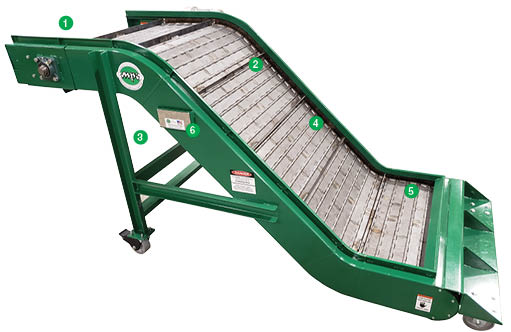
The MPI Steel Hinge Belt Conveyor (SBC) from Magnetic Products, Inc. (MPI) is a heavy-duty conveyor for sharp, hot, oily or abrasive material such as stamping slugs, metal scrap, steel chips, turnings, forgings, die-cast parts and fasteners. It moves both ferrous and non-ferrous material and is built to order from standard MPI components in three belt pitches. Production Resources, Inc. (PRI) helps press rooms and machining lines configure and quote SBC conveyors.
For background on hinged steel belt conveyors and how they compare with other scrap conveyors, see PRI's steel hinge conveyors guide.
Key Features
- Three duty levels
- Standard (2.5-in. pitch), Heavy (4-in. pitch) and Extra Heavy (6-in. pitch); each step up adds a heavier belt and frame for tougher scrap or higher scrap rates.
- Choice of belt surface
- Plain, flat top, pimpled, perforated, or pimpled and perforated. Perforated plates let coolant or oil drain to a catch pan below the belt.
- Jam-resistant belt design
- Interlocking side wings keep material from wedging at the belt edges, and cleat size and spacing can be specified to push parts up an incline.
- Built-in torque limiter
- Part of the standard SBC design rather than an add-on.
- Wear-focused construction
- Heat-treated belt rollers, heavy-duty angle iron tracks and 11-gauge belts on the 2.5-in. and 4-in. pitches. Flanged rollers can be fitted on no rollers, every other roller, or all of them.
- Safety bottom pans and U.S.-made drives
- Safety bottom pans come standard, and the standard drive package is a U.S.-manufactured Baldor TEFC unit.
Product Line / Models
The SBC series is organized by belt pitch, and MPI helps select the right duty for each application:
- 2.5-in. pitch (Standard duty) – 8.5-in. frame depth, 12-gauge frame; the lightest belt in the series.
- 4-in. pitch (Heavy duty) – 15.25-in. frame depth, 10-gauge frame, for tougher scrap or higher rates.
- 6-in. pitch (Extra Heavy duty) – 23.25-in. frame depth on a structural channel frame, for the most difficult scrap and highest volumes.
Each conveyor is then laid out to fit the machine and the discharge point:
- Shape: horizontal straight; incline straight with nose-over; incline straight with horizontal or continuous-radius discharge; dogleg nose-over; dogleg with horizontal or continuous-radius discharge
- Incline angle: 15°, 30°, 45°, 60°, 75° or custom
- Infeed and discharge: infeed length from a 12-in. minimum; discharge length and height set by the application
- Belt width: standard widths in 2-in. steps from the minimum for the chosen pitch up to 48 in.
Applications & Benefits
- Press-room scrap removal: takes slugs and trim from a press, machine or hopper and delivers them to a tote, bin, furnace or crusher.
- Hot parts: the all-steel belt resists heat, impact and cutting damage that ruins rubber or fabric belts, and optional smoke covers contain smoke from hot parts.
- Coolant-wet chips: perforated belts and optional coolant recovery trays pull fluid out of chips and turnings on machining lines.
- Ferrous parts on inclines: an optional magnetic bed section holds ferrous material on the belt.
- Complete material handling systems: SBC conveyors can ship with feeders, hoppers, loading baffles and discharge chutes. MPI has built them for deep-draw metal processing, HVAC part manufacturing and a Tier-1 automotive OEM.
Technical Specifications (from MPI Datasheet)
MPI publishes these standard values for the three belt pitches; all other dimensions follow the customer's configuration, and MPI notes that specifications are subject to change.
- Power input: 230/460 V, 3-phase, 60 Hz (standard); 115/230 V single-phase or 575 V 3-phase available
- Drive location: offset drive (standard), underhead chain drive or overhead chain drive; motor on the right (standard) or left, looking in the direction of travel
- Speed: varies with belt design
- Mounting: floor installation is standard, which sets infeed height at the body depth; adjustable legs raise the infeed, and V-wheel or 5-in. rigid or swivel casters (with or without brakes) are optional at either end
- Controls: not included as standard; supplied when specified
- Paint: MPI green (standard), MPI light gray or customer-specified color
- Other options: abrasion-resistant track liners, body inspection doors and custom side guides
 Download the MPI Steel Hinge Belt Conveyor (SBC) datasheet for full options
How to Choose the Right MPI Steel Hinge Belt Conveyor
- Material: size, shape, temperature, and whether it arrives oily or coolant-wet; these drive belt pitch and belt surface.
- Scrap rate: higher volumes and harder-to-handle scrap point to the 4-in. or 6-in. pitch.
- Path: horizontal, incline or dogleg, and the incline angle.
- Infeed: the height available under the press or machine, and how long the loading zone must be.
- Discharge: the height and reach needed to clear your hopper, tote or next conveyor.
- Belt width: wide enough to catch all the scrap, in 2-in. steps up to 48 in.
- Power and controls: plant voltage and phase, and whether the conveyor should run from press or line controls.
Why MPI Steel Hinge Belt Conveyors Are Trusted
- All-steel belt: handles heat, impact and abrasion across all types of metal.
- Protection built in: a standard torque limiter, safety bottom pans and heat-treated rollers.
- Engineered to the job: custom layouts built from standard MPI components, driven by American-made drive packages.
Contact & Ordering
Need help picking the right model or getting a quote? Provide these details:
- Material conveyed: type, size, temperature, and whether it is oily or wet
- Approximate scrap rate
- Infeed height and length available at the press or machine
- Discharge height and the container or conveyor it feeds
- Required belt width and path (horizontal, incline or dogleg)
- Plant power (voltage and phase) and control needs
Contact PRI to discuss specs, lead times, and installation support.