

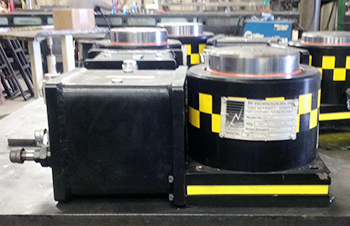
Hydraulic shock dampers sit on the press bed beside the die and absorb the reverse load released when a blanking, piercing or trim punch breaks through the material. Sized and adjusted correctly, they take the bang out of breakthrough and protect the press and the die. PRI supplies W-Technologies dampers.
Shop Shock DampersRequest a QuoteCall (800) 863-3164Snap-Through Shock · How They Work · Who Needs Them · Benefits · Sizing · What We Need · FAQs
What Is Snap-Through Shock?
When a blanking, piercing or trim punch cuts through the material, the force the press built up is released all at once. That sudden release is called snap-through or breakthrough shock. The press frame, slide and drive, which stretched under the load, spring back, and the force that travels back through the slide and linkage is the reverse load, also called negative tonnage.
Repeated reverse load fatigues the press. It cracks drive linkages, slides, crowns, beds and housings, and hydraulic lines and bolts usually fail first. It also wears punches and dies early and makes a lot of noise. To protect against it, presses are derated for blanking; W-Technologies notes that reverse load can cut a press’s blanking capacity by up to two-thirds of its forming rating. Stamping high-strength steel raises the force needed, and with it the noise, vibration and wear.
A tonnage monitor that displays reverse load shows how much your press sees on every stroke. See the tonnage monitor guide.
How Hydraulic Shock Dampers Work
Dampers are installed next to the tooling on the bed of the press. A striker plate or counter-pressure post meets the damper pistons at the point in the press stroke where the punch contacts the material. As the blanking force builds, the pistons retract with little resistance, bypassing oil through internal orifices and pressure valves in the cylinder; W-Technologies puts the added load at a nominal 3 to 5% of forward tonnage. At the moment of breakthrough, those passages restrict the oil, and the dampers resist the sudden downward acceleration of the press slide and tooling.
The result is an upward counter-pressure at breakthrough. Properly sized and adjusted, the dampers eliminate the reverse load without derating the press. Because they push back as long as forward tonnage is applied, individually adjusted dampers also counter off-center loading of the slide, left or right of center.
W-Technologies H Series dampers are self-contained. The cylinder mounts on a steel manifold that is the base of the unit, with the hydraulic reservoir attached. Pressure is set externally with a 3/16" hex wrench in minutes, so one set covers a range of jobs and moves from press to press as easily as tooling. Models, ratings and options are on the W-Technologies product page.
Who Needs Shock Dampers?
Hydraulic shock dampers pay off in any blanking, punching or die trimming application in metal, plastics or composites that is seeing excessive reverse shock, premature die wear, fatigued press components or hydraulic system failure at part breakthrough. They work in both mechanical and hydraulic presses. W-Technologies lists these warning signs:
What Dampers Do for the Press
These are W-Technologies’ published figures. Results depend on sizing and adjustment, which is why PRI and W-Technologies start with your press and job data.
How to Size Shock Dampers
- 1Establish the reverse loadRead it from a tonnage monitor that displays reverse load, or estimate it from the material’s yield-to-tensile ratio with W-Technologies’ Reverse Load Factor method. PRI and W-Technologies can run the numbers from your job data.
- 2Decide how many and whereW-Technologies’ technical paper prefers four dampers, one at each corner of the bed, with two (one at each end) as the alternative. Dampers work best on the bed next to the die, so check the open bolster area.
- 3Size each damperDivide the total reverse tonnage by the number of dampers and choose the size that covers it within the 5,000 psi rating.
- 4Check the strokeDamper stroke is short and is set with shims or striker plates; the shortest stroke is material thickness plus a preload that varies with damper size. Breakthrough has to happen near the bottom of the press stroke.
- 5Check speed and heatDamper stroke, strokes per minute and internal pressure decide how hot the oil gets, and too much heat damages the seals. W-Technologies’ heat charts show whether you need the optional water cooling, a cooling plate built into the reservoir.
- 6Plan for other jobsExternal pressure adjustment lets one set cover a tonnage range and move between presses. List the other dies and presses the dampers might serve.
Tell us these and we’ll provide a recommendation:
- Press type (mechanical or hydraulic), make and tonnage
- Press stroke and strokes per minute
- Forward tonnage of the job, and reverse tonnage if measured
- Material type and thickness
- Tensile and yield strength
- Where in the stroke breakthrough occurs
- Available bolster space around the die
- Other dies or presses the dampers should serve
Shock Damper Brand PRI Offers
W-Technologies is on our Additional Manufacturers line card.
Help From PRI
PRI’s Application Engineers can help you determine which shock dampers are right for your application. Tell us your press tonnage, material type, material thickness, yield strength, press stroke and available bolster space, and we’ll provide a recommendation with W-Technologies. If you don’t know your reverse load, a Wintriss tonnage monitor with reverse load display will show it. PRI supports installation and startup and trains your setup people to adjust the dampers for each job. See PRI services.
Shock Damper Downloads
Frequently Asked Questions
What are hydraulic shock dampers?
Hydraulic cylinders installed on the press bed next to the tooling. They absorb the energy released when material fractures in blanking, punching and die trim, without derating the press, by providing an upward counter-pressure at the moment of breakthrough.
Who needs shock dampers?
Any blanking, punching or die trimming application in metal, plastics or composites that is experiencing excessive reverse shock, premature die wear, fatigued press components or hydraulic system failure at part breakthrough.
Is snap-through shock the same as breakthrough shock?
Yes. Both names describe the sudden release of force when the press’s energy exceeds the material’s shear strength and fractures it. The force that comes back through the slide and linkage is the reverse load, or negative tonnage.
How much more blanking capacity will dampers give me?
Presses are normally derated for blanking to protect them from reverse load. W-Technologies says that with the reverse load fully captured, 95 to 97% of the press’s forming tonnage is available for blanking.
Can dampers be moved from press to press?
Yes. W-Technologies dampers are adjusted externally and can be moved from press to press as easily as tooling. Custom dampers are built for a particular tool but are not limited to it, within their recommended tonnage range.
Do shock dampers need cooling?
Some do. Heat in the oil depends on damper stroke, strokes per minute and internal pressure. W-Technologies offers water cooling through a cooling plate built into the reservoir, which keeps the unit self-contained.
Do dampers work on hydraulic presses?
Yes. W-Technologies dampers are used in both mechanical and hydraulic presses, and they address hydraulic system failure at breakthrough, one of the common signs of reverse load.
Related Guides
Press Room Accessories · Tonnage Monitors · Press Mounts & Isolators · Die Protection & Press Automation · Power Presses
Send us the press and the job. PRI will size the dampers with W-Technologies and quote them.
Shop Shock DampersRequest a QuoteCall (800) 863-3164