

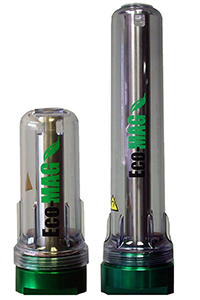
Magnetic filters use rare earth magnets to pull ferrous and paramagnetic particles, down to sub-micron size, out of coolants, oils and other machine fluids. They usually work alongside the filtration you already have to extend fluid life, protect pumps and machines and improve part finish. Production Resources, Inc. (PRI) supplies MPI’s Eco-Mag and self-cleaning AutoMag filters.
Shop Magnetic FiltersRequest a QuoteCall (800) 863-3164How It Works · The Filters · Eco-Mag or AutoMag · Where Used · Choosing · What We Need · FAQs
How Magnetic Filtration Works
MPI magnetic filtration products separate tramp metal and fines from machine lubrication and coolant systems. They are often used to complement existing filtration in order to extend lubricant life, improve machine life and improve part quality.
The fluid is pumped through the filter and over a high-intensity rare earth magnetic core. Ferrous and paramagnetic particles are pulled onto the core and held there, and the clean fluid flows on. A paper, bag or cartridge filter only stops particles larger than its pores. A magnetic filter is not particle-size sensitive: if a particle is magnetic, it is captured, from larger chips down to sub-micron fines.
Because nothing has to pass through a medium, a magnetic filter adds little restriction to the flow. When the core is loaded, the debris comes off as dry, solid metal that can be disposed of or recycled. There are no oil-soaked cartridges to throw away.
MPI Magnetic Filters
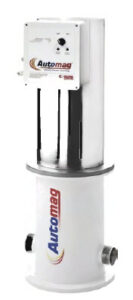
Eco-Mag or AutoMag?
| MPI Eco-Mag | MPI AutoMag | |
|---|---|---|
| How it is cleaned | By hand when the core is full, with the supplied tool, in under 30 seconds | Automatically: a control signal starts a purge that takes about 10 to 15 seconds, depending on the fluid and the filter location |
| Suited to | Individual machines and fluid lines; compact, fits tight spaces | High flow rates and heavily contaminated fluid, running continuously without an operator |
| Fluids | Lubricants, coolants and other industrial fluids | Oil, coolant and water-based fluids, including wash water |
| Installation | In the shop fluid line | Inline in the process, or offline in its own filtration loop; before or after holding tanks or at the machine inlet |
| Utilities and extras | None | A small volume of compressed air, a control signal, an outlet valve (required, not included) and a purge tank or reclaim unit; timer or PLC controls, skids and multi-unit systems are options |
| Consumables | None | None |
From MPI’s Eco-Mag and AutoMag pages. Confirm the model, flow rate and ratings with PRI when you quote.
What Magnetic Filtration Does for You
Where Magnetic Filters Are Used
Grinding, honing, milling and other CNC machining, fine finishing, industrial parts washing (including vehicle pre-paint body wash stations), and pump protection: anywhere a lubricant, coolant, wash fluid or other process fluid picks up ferrous particles. In a stamping plant that usually means the tool room grinders, the machine shop and the parts washers.
How to Choose a Magnetic Filter
- 1Name the fluid and the processStraight oil, water-based coolant or wash water, and what the machine does: grinding, honing, machining or washing.
- 2Work out flow and contaminationTotal flow rate and how much ferrous debris the fluid carries. High flow or heavy contamination points to the AutoMag, sometimes several units together.
- 3Decide how it will be cleanedAn operator cleans the Eco-Mag by hand in under 30 seconds. The AutoMag purges itself on a signal from a timer or PLC, which suits continuous production.
- 4Choose where it goesIn the fluid line at the machine, before or after a holding tank, or in an offline loop that filters the tank on its own.
- 5Keep the filters you haveA magnetic filter catches the ferrous load; your existing filter still catches non-magnetic debris. For bag filters, a filter bag magnet goes inside the bag housing.
- 6Check pressure, temperature and spaceGive PRI the line pressure, fluid temperature and the space available so the filter can be checked against MPI’s ratings.
Send what you have:
- Fluid type (oil, water-based coolant, wash water)
- Machine and process (grinding, honing, machining, washing)
- Flow rate and line size
- Contaminant: what it is and roughly how much
- Current filtration and how often it is changed
- Operating pressure and temperature
- Inline or offline installation, and space available
- Manual cleaning or automatic purge; air and control signal available
The Brand PRI Offers

Help From PRI
PRI’s Application Engineers size the filter to your flow and contamination, decide where it goes in the system and how it will be cleaned, and work with MPI on multi-unit or high-flow systems. PRI supports installation and startup of automatic filters, trains your team on cleaning and purge setup, and helps with parts and repairs. See PRI services.
Frequently Asked Questions
What do magnetic filters remove?
Ferrous and paramagnetic particles: steel and iron fines, chips and grinding swarf picked up by lubricants, coolants, wash fluids and other process fluids. MPI’s filters capture them down to sub-micron size.
Do magnetic filters replace my existing filters?
Usually not. Magnetic filters are often used to complement existing filtration. They take the ferrous load off your filters, which extends filter and fluid life, while the existing filter still catches non-magnetic debris.
How small a particle can a magnetic filter catch?
MPI’s Eco-Mag and AutoMag are not particle-size sensitive. If a particle is magnetic, it is captured, including sub-micron particles that pass through conventional filter media.
How is a magnetic filter cleaned?
The Eco-Mag is cleaned by hand with the supplied tool in under 30 seconds, leaving dry metal waste. The AutoMag cleans itself: a pneumatic cylinder withdraws the magnetic cores and the debris is flushed to a purge tank, typically in 10 to 15 seconds.
Do magnetic filters need consumables?
No. There are no cartridges, bags or media to replace. The AutoMag uses a small volume of compressed air to purge.
Will a magnetic filter catch aluminum or brass?
No. Magnetic filters are made for ferrous debris. Aluminum, brass and other non-ferrous chips need conventional filtration, which is one reason magnetic filters are used together with your existing filters.
Related Guides
MPI Magnetic Products · Magnetic Lifters · Sheet Fanners & Separators · Demagnetizers · Press Room Accessories · Conveyor Systems
Send us the fluid, the flow rate and the process. PRI will recommend the MPI magnetic filter that fits and quote it.
Shop Magnetic FiltersRequest a QuoteCall (800) 863-3164