Overview
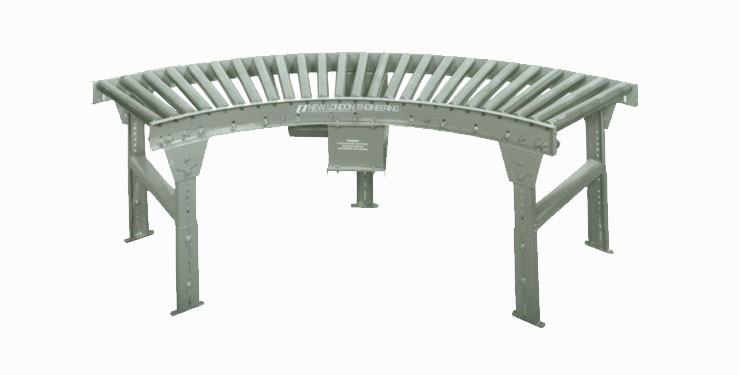
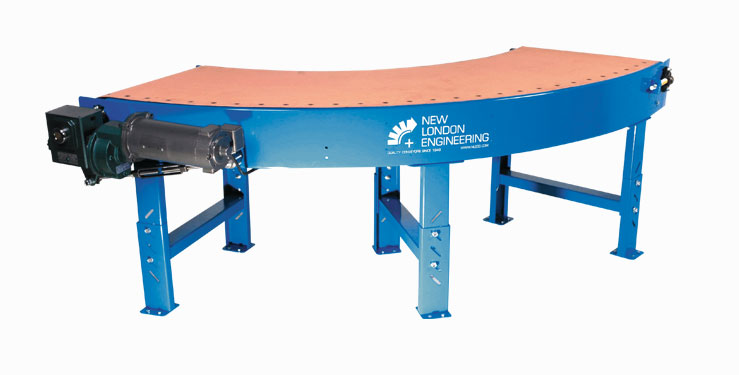
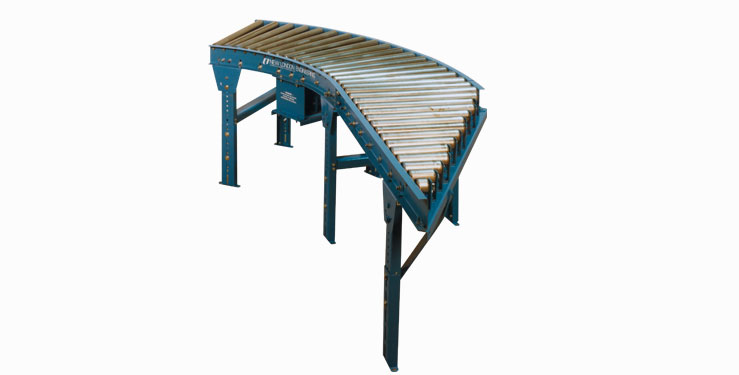
New London Engineering powered curve conveyors change product direction while maintaining product orientation. The family includes V-belt driven live roller curves, Models 630 (30°), 645 (45°) and 690 (90°), in widths from 12" to 36", and Medium to Heavy Duty Belt Curves, flat-top belt curves up to 48" wide in arcs from 15° to 180° at speeds up to 400 FPM. PRI supplies New London Engineering powered curves alongside the rest of the NLE line.
Key Features
- V-belt driven live rollers
- On the 630, 645 and 690, V-belt driven live roller spurs are used to merge product lines.
- Straight or tapered rollers
- Each V-belt curve angle is offered with straight rollers or with tapered and straight rollers; the 30° tapered version is Model 631.
- Flat-top belt curves
- On the belt curves, all components sit below the belt's surface, so products wider than the belt will orientate through the curve.
- Positive orientation
- Belt curves are chosen over roller curves where positive orientation is critical, such as baggage handling or printing operations.
- Speeds to 400 FPM
- Belt curves run at speeds up to 400 FPM. V-belt roller curves run at a 60 FPM standard speed.
- Multiple surface options
- Several curve angles and multiple surface options are available.
Product Line / Models
New London Engineering powered curve models and standard specifications:
- Model 630 V-Belt Driven Curve (30°) – widths 12", 18", 24", 30" and 36", 60 FPM, 1/2 HP 230/460/3/60 TEFC motor, bottom-mount drive, 12 ga frame, 2" diameter x 16 ga rollers with 7/16" hex shafts on 2-5/8" centers at the inside rail. Straight rollers; Model 631 has tapered and straight rollers.
- Model 645 V-Belt Driven Curve (45°) – widths 12", 18", 24", 30" and 36", 60 FPM, 1/2 HP, bottom-mount drive, 12 ga frame, 2" x 16 ga rollers on 2-5/8" inside-rail centers. Straight rollers, or tapered and straight rollers.
- Model 690 V-Belt Driven Curve (90°) – widths 12", 18", 24", 30" and 36", 60 FPM, 1/2 HP, bottom-mount drive, 12 ga frame, 2" x 16 ga rollers on 2-5/8" inside-rail centers. For product lines requiring a 90° turn. Straight rollers, or tapered and straight rollers.
- Medium to Heavy Duty Belt Curves (Power Belt Curves) – widths up to 48", arcs from 15° to 180°, speeds up to 400 FPM, 1/2 HP 230/460/3/60 motor, end drive shaft mounted at the discharge on the outside radius, black PVC 120 belt with clipper lacing, 12 ga frame, 12 ga formed channel supports. Flat-top design with all components below the belt surface.
Applications & Benefits
- Merging product lines: V-belt driven live roller curves merge product lines.
- Turning conveyor lines: 30°, 45° and 90° roller curves change product direction while maintaining orientation.
- Baggage handling: Belt curves are used where positive orientation is critical.
- Printing operations: NLE names printing as a belt curve application where orientation matters.
How to Choose the Right New London Engineering Powered Curve
- Set the turn: 30°, 45° or 90° for V-belt roller curves, or an arc from 15° to 180° for a belt curve.
- Check the width: 12" to 36" for roller curves, up to 48" for belt curves.
- Where positive orientation is critical, or products are wider than the belt, choose a belt curve.
- Match the speed to the line: 60 FPM standard on V-belt curves, up to 400 FPM on belt curves.
- For roller curves, choose straight rollers or tapered and straight rollers.
Why New London Engineering Powered Curves Are Trusted
- Quality conveyors since 1948: New London Engineering of New London, Wisconsin has built conveyors since 1948 and describes its line as American made and American engineered.
- Orientation held through the turn: NLE powered curves change product direction while maintaining product orientation.
- Clean belt surface: On NLE belt curves, all components sit below the belt's surface.
Contact & Ordering
Need help picking the right model or getting a quote? Provide these details:
- Product size, weight, and whether it must keep its orientation
- Turn angle and direction (right or left hand)
- Conveyor width and line speed
- Roller curve or belt curve; straight or tapered rollers
- Heights and widths of the connecting conveyors
- Available power (voltage and phase)
- Contact PRI to discuss specs, lead times, and installation support.