

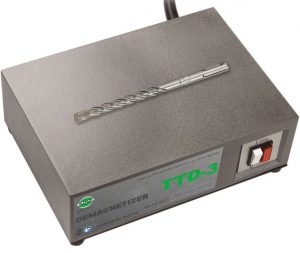
A demagnetizer removes the residual magnetism that steel parts, tools and dies keep after magnetic workholding, lifting or conveying. Pass the part across an alternating field and slowly withdraw it, and the magnetism is gone. Production Resources, Inc. (PRI) supplies MPI tabletop demagnetizers, for the bench or under a conveyor belt, and MPI’s handheld demagnetizer for dies, molds and large parts.
Shop DemagnetizersRequest a QuoteCall (800) 863-3164Why Demagnetize · How It Works · Types · At a Glance · Choosing · What We Need · FAQs
Why Demagnetize Parts?
Steel often keeps some magnetism after it has been near a magnetic field: a magnetic chuck, a lifting magnet, a magnetic conveyor or a sheet fanner. How much depends on the material and the size of the part. That residual magnetism can interfere with the next step: chips and fines cling to the part, gauging and sensors read wrong, parts stick together in assembly, and in welding it can pull the arc off line.
A demagnetizer takes it out. PRI distributes a range of MPI products that make your operation run more smoothly, including the tabletop demagnetizer, which can be used by hand or installed as part of an automated process, such as under a conveyor belt.
How a Demagnetizer Works
When a magnetized part is placed on or passed over the demagnetizer, it crosses an alternating magnetic field of opposite polarity to its own. That field disrupts the aligned magnetic domains in the steel. As the part moves slowly across the plate and is gradually withdrawn from the field, the domains lose their alignment and return to a random state, and the residual magnetism is neutralized.
The key is a steady movement across the active field and a slow withdrawal. Pulling the part away quickly can leave magnetism behind. On MPI’s tabletop demagnetizer the field adjusts automatically to the size of the workpiece.
MPI Demagnetizers
MPI Demagnetizers at a Glance
| Model | Size L x W x H | Weight | Field depth | Power |
|---|---|---|---|---|
| TTD-3 tabletop | 9.84 x 7.09 x 3.43 in. (250 x 180 x 87 mm) | 19.4 lb | Up to 40 mm (1.57 in.) | 110V/60Hz, 352 VA |
| TTD-4 tabletop | 11.02 x 10.47 x 3.43 in. (280 x 266 x 87 mm) | 30.9 lb | Up to 40 mm (1.57 in.) | 110V/60Hz, 352 VA |
| TTD-5 tabletop | 13.75 x 12.05 x 3.43 in.* | 41.9 lb | Up to 40 mm (1.57 in.) | 110V/60Hz |
| HHDM-HD2 handheld | 8.5 x 6.3 x 3.3 in. (216 x 160 x 84 mm) | 4.85 lb | Up to 1.57 in. (40 mm) | 110 VAC |
From MPI’s tabletop and handheld demagnetizer pages and MPI’s TTD product data. *MPI’s metric table lists the TTD-5 at 400 x 306 mm; PRI will confirm the length. The TTD also has a double-pole switch with a signal light. Confirm current ratings with PRI when you quote.
How to Choose a Demagnetizer
- 1Part size and shapeFlat and small cylindrical parts go on a tabletop unit: pick the TTD size that covers the largest footprint, or put several side by side. Dies, molds and large or complex parts call for the handheld unit.
- 2Part thicknessCheck the thickness against the field depth: up to 40 mm (1.57 in.) on both the tabletop and handheld units.
- 3By hand or inlineAt a bench, the operator passes parts across the plate. Inline, the tabletop unit mounts under a conveyor belt and parts are demagnetized as they pass; tell us the belt width and speed.
- 4How many partsHigh, steady volumes suit a tabletop unit under a conveyor. The handheld unit is for intermittent work, within its 20% duty cycle and 10-minute maximum run.
- 5PowerBoth run on 110V power. Confirm a 110V/60Hz outlet at the work location.
- 6Your residual limitIf your customer specifies a maximum residual magnetism, plan to check parts with a gauss meter.
Send what you have:
- Part material, size, shape and weight
- Part thickness
- Where the magnetism comes from (chuck, lifter, conveyor, fanner)
- Residual magnetism limit, if one is specified
- Parts per hour or batch size
- By hand or under a conveyor; belt width and speed
- Power available at the work location
- Number of units
The Brand PRI Offers

Help From PRI
PRI’s Application Engineers pick the demagnetizer size for your parts, plan how it fits under a conveyor or at a bench, and look at where the magnetism comes from in the first place. PRI supports installation and startup, shows operators the right technique, and helps with parts and repairs through MPI. See PRI services.
Frequently Asked Questions
What does a tabletop demagnetizer do?
It removes residual magnetism from flat and small cylindrical parts. Parts are placed on, or passed across, the stainless steel top plate. It can be used by hand or installed as part of an automated process, such as under a conveyor belt.
Can a demagnetizer be used under a conveyor?
Yes. MPI’s tabletop demagnetizer can be placed under a conveyor belt so parts are demagnetized automatically as they pass over it.
What sizes are available?
MPI’s tabletop demagnetizer comes in three sizes, TTD-3, TTD-4 and TTD-5, up to 13.75 x 12.05 in. Custom sizes are available by special order, and several units can be placed side by side for a larger work area.
How thick a part can it demagnetize?
The field penetrates up to 40 mm (1.57 in.) on MPI’s tabletop and handheld demagnetizers.
How do I demagnetize a die or a mold?
Use MPI’s handheld demagnetizer. Move it slowly across the surface and then gradually away. It reaches large and complex parts that a tabletop unit can’t.
How do I know a part is fully demagnetized?
Measure it. A gauss meter shows the residual field at the part surface, so you can check it against your limit.
Related Guides
MPI Magnetic Products · Magnetic Filters · Magnetic Lifters · Sheet Fanners & Separators · Magnetic Conveyors · Press Room Accessories
Send us your part size, thickness and volume. PRI will recommend the MPI demagnetizer that fits and quote it.
Shop DemagnetizersRequest a QuoteCall (800) 863-3164