

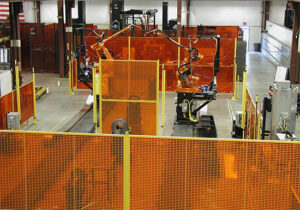
Perimeter and area guarding keeps people out of the hazard zone around a machine, robotic cell or line, or stops the equipment when someone enters it: wire barrier guards, multi-beam light curtains, safety laser scanners and safety mats. PRI helps you choose the mix and lay it out.
View All Perimeter GuardingRequest a QuoteCall (800) 863-3164Methods · Barriers · Light Curtains · Laser Scanners · Safety Mats · Choosing · What We Need · FAQs
Perimeter Guarding Methods
Perimeter guarding protects people around coil lines, robotic cells, turret presses, automated work cells and similar equipment. A physical barrier keeps people out. A presence-sensing device lets them in but stops the process when they enter. The two are often combined, for example a wire barrier on three sides and a light curtain at the access point.


Physical Barrier Guards
Physical barrier guards should be considered where frequent access to, and maximum visibility of, the process aren’t the main concern. A barrier is often combined with presence-sensing devices for a more flexible and complete guarding system. WireCrafters woven and welded wire barriers are a practical, easy to use and maintain guarding system for robotic cells, automated work cells and general perimeter guarding. A wire barrier has no electrical parts to fail, and the mesh helps contain fragments, projectiles or scrap from a process malfunction while keeping the guarded area in view.
PRI can help you configure a barrier system to meet your needs; we have experience configuring practical safeguarding without hurting productivity. WireCrafters also makes tool cribs, employee separation panels and security cages; see them in the catalog.
Perimeter Light Curtains
Coil lines, robotic cells, turret presses and similar perimeter guarding jobs can be protected with an HTM body-protection light curtain system. A transmitter and receiver pair detects anyone entering the process area from the front and starts a line shutdown. A second set can guard the back of the process, or mirrors and stands can make a three-sided protection zone. Reset can be automatic or manual, with a customer-supplied key switch.
HTM SE4-Q body-protection systems come in 2-, 3- and 4-beam Category 4 versions, with protected heights from 21.37" to 48.93" (543 to 1,243 mm) and an operating range of 0.5 to 25 m. They need a 24 VDC power supply and a safety relay in addition to the optics. For finger and hand protection at the point of operation, see our safety light curtain guide.
Safety Laser Scanners
A safety laser scanner is an optical sensor that scans its surroundings in two dimensions with infrared laser pulses and measures how long each pulse takes to reflect back (time of flight). You program protective fields and warning fields around the hazard. Any interruption of a protective field drops the scanner’s safety outputs (OSSDs) and sends a stop signal to the machine’s primary control elements (MPCE). A warning field drives a non-safety output to a light, PLC or display to warn that someone is about to enter.
Because the fields are programmed, scanners suit irregular areas, access protection, robot stations and guided vehicles. Several field sets can be stored and switched by a selector switch or PLC as equipment moves in and out of an area, so the scanner doesn’t have to be reprogrammed every time something changes. Safety laser scanners are Type 3 devices under IEC 61496-3, so they are used for area and access guarding where a risk assessment supports that level, not for point-of-operation guarding on a press. PRI supplies safety laser scanners from Rockford Systems.
Safety Mats
Safety mats, also called safeguarding mats, are presence-sensing safety devices used to monitor an area: around fabricating machines, as supplemental guarding, and for area guarding that protects passersby, helpers and primary operators. Miller Edge mats are made of two conductive plates held apart by compressible, non-conductive separators. Stepping on the mat compresses the separators and the plates make contact, which signals a stop. Mats can be wired in series to cover a continuous area, and a fault in the wiring also signals a stop.
One mat or several are wired to a control device, and the system’s safety rating depends on that controller and the whole system, not on the mat alone. Mats are best suited to supplemental and area guarding where there is no likelihood of serious injury such as amputation or crushing.
How to Plan Perimeter Guarding
- 1Map the hazard zoneSketch the area, the equipment in it and every way in: aisles, doors, conveyors and material openings.
- 2Decide who needs in, and how oftenPoints used rarely get barriers with interlocked doors; points used often get light curtains, scanners or mats.
- 3Set the safety distanceA presence-sensing device has to be far enough out that the equipment stops before someone reaches the hazard. The equipment’s stopping time sets it.
- 4Pick the device for each openingLight curtains for defined openings, scanners for irregular areas or changing layouts, mats for supplemental coverage, and barriers for the rest.
- 5Plan interlocks and resetDoor interlocks, whether the system resets automatically or manually, and where the reset switch goes.
- 6Tie it into the controlSafety relays or a safety controller, wired into the machine’s stopping circuits.
A layout sketch and a few photos answer most of these:
- Layout sketch or dimensions of the area
- Equipment inside (robot, coil line, press, conveyors)
- Access points and how often each is used
- Barrier height and gap at the floor
- Doors, lift-out panels and interlocks needed
- Stopping time of the equipment, if known
- Environment (wash-down, welding, heavy impact)
- Control: safety relay, safety PLC or machine control
Perimeter Guarding Brands PRI Offers

These lines are on our Additional Manufacturers line card.
Help From PRI
PRI analyzes machine and perimeter guarding for coil lines, presses and robotic work cells, measures stopping time to set safety distances, and helps you lay out and install the system. See PRI services.
Perimeter Guarding Downloads
Frequently Asked Questions
What is perimeter guarding?
Perimeter (area) guarding protects people around a machine, robotic cell or line by keeping them out of the hazard zone with a physical barrier, or by stopping the equipment when someone enters it, using light curtains, safety laser scanners or safety mats.
Should I use a barrier guard or a light curtain?
Barrier guards suit areas where frequent access and maximum visibility of the process aren’t important. Presence-sensing devices suit openings people need to go through often. Most cells combine the two.
How does a safety laser scanner work?
It scans its surroundings in two dimensions with infrared laser pulses and measures the time each takes to reflect back. Programmed protective fields stop the machine when entered; warning fields give an early warning through a non-safety output. Field sets can be switched by a selector switch or PLC.
Are safety mats Category 4?
Not on their own. A mat system’s safety rating depends on the controller and the whole system. Mats are best suited to supplemental and area guarding where there is no likelihood of serious injury such as amputation or crushing.
What heights do WireCrafters machine guards come in?
WireCrafters lists machine guarding heights of 5 ft-3-1/4 inches and 8 ft-5-1/4 inches with a 3-1/4 inch sweep at the floor, and special heights are available. RapidGuard lift-out panels come in about 6 ft and 8 ft heights.
Related Guides
Press & Machine Safeguarding · Safety Light Curtains · Press Brake Guarding · Die Doors · Clutch/Brake Controls
Send us a sketch of the area and how people use it. PRI will recommend the barriers and devices and quote the system.
View All Perimeter GuardingRequest a QuoteCall (800) 863-3164