Use this form to let us know what part(s) you're looking for and we'll get a quote to you ASAP. To get a quote sooner, call us at 800-863-3164 Monday to Friday during normal business hours.
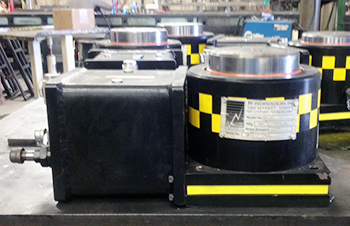
W-Technologies H Series hydraulic shock dampers are self-contained cylinders that bolt to the press bed beside the die and absorb the reverse tonnage released at breakthrough. They are designed and built by W-Technologies Hydraulic Dampers LLC in Mt. Carmel, Illinois, and Production Resources, Inc. (PRI) supplies them to shops running blanking, punching and die-trim work on both hydraulic and mechanical presses. Standard sizes and custom builds are available.
An external flow control (needle) valve sets counter-pressure; a 3/16" hex wrench changes it in minutes, so one set covers a wider tonnage range and can move from press to press.
Built-in 5,000 psi relief valve
Caps H Series operating pressure at 5,000 psi so the cylinder cannot be over-pressurized.
Swappable external orifice
The fixed orifice is matched to the press's normal cycling speed and can be changed without taking the damper apart, which lets a set move to a faster press.
Steel manifold base with attached reservoir
The cylinder/piston assembly mounts on a steel manifold that houses the valves, carries the hydraulic reservoir and bolts solidly to the press bed.
Pressure gauge test port and sight gauge
The removable test port confirms the pressure setting before production; the sight gauge shows oil level and temperature.
Optional water cooling
For high-speed jobs, aluminum cold plates built into the reservoir circulate chilled water. The unit stays self-contained and uses no floor space.
Parker Hannifin seals, rebuildable design
Parker Hannifin seal packages; in a rebuild, only wear components are replaced and the core stays in service.
Tooling-style setup
Installation is comparable to setting a die. Orders include an installation manual, and W-Technologies offers installation help and ongoing technical support.
Product Line / Models
W-Technologies builds standard H Series dampers rated for 5,000 psi internal pressure, with individual cylinder capacities from 12 tons to over 250 tons, plus custom units:
H12 – The smallest W-Technologies damper: a 4-1/2" x 7-13/16" footprint and 7-5/16" height. Each unit absorbs up to 12 tons of reverse load. Used in pairs, they fit in the press or inside the die itself.
H35, H50, H70, H100, H125, H150 – Standard H Series cylinders for larger reverse loads. Capacity at each pressure setting is listed in the table below.
Custom dampers – Built to the application. The largest W-Technologies has made, a pair of U1000 units built in 1998, were resealed in 2008 and again in 2019.
Applications & Benefits
Quieter press lines: Correctly sized dampers cut breakthrough noise and vibration on hydraulic and mechanical presses.
Longer die life: W-Technologies reports 3 to 5 times longer tool life when dampers are used properly.
More usable blanking tonnage: With all reverse load captured, 95–97% of a press's forming tonnage is available for blanking, so heavier jobs fit smaller presses.
Off-center dies: Individually adjusted dampers counter slide loading left or right of center.
Higher stroke rates: Presses slowed down to live with shock can often be set to run faster once dampers are installed.
Less press downtime: In an informal W-Technologies survey, users who had press failures before installing dampers saw downtime fall by as much as 75%.
Technical Specifications
W-Technologies publishes this conversion of H Series internal pressure to reverse-load capacity per damper:
Oil heat depends on damper stroke length, press strokes per minute and internal pressure. Stroke is set with shims or striker plates; the shortest workable stroke is material thickness plus a size-dependent preload. W-Technologies supplies model heat charts to show whether cooling is needed.
How to Choose the Right Hydraulic Shock Dampers
Establish the reverse load. Read it from a tonnage monitor that records negative tonnage, or estimate it with W-Technologies' Reverse Load Factor (based on the material's yield-to-tensile ratio).
Decide quantity and placement. Four dampers, one per bed corner, is preferred; two, one at each end, is the usual alternative. Dampers work best beside the die, so confirm open bolster area.
Size each damper. Divide total reverse tonnage by the number of dampers, then pick the H Series size, or H12 pair, that covers it within the 5,000 psi rating.
Check the stroke. Damper stroke is short (about 2" to 2-1/2" per W-Technologies' technical paper), so breakthrough must occur near the bottom of the press stroke.
Check speed and heat. Compare strokes per minute, damper stroke and pressure against W-Technologies' heat data to decide whether water cooling is required.
Why W-Technologies Dampers Are Trusted
Made in the USA by a damper specialist: Built in Mt. Carmel, Illinois, by a company whose core business is hydraulic shock dampers, from engineering through after-sales support.
Proven service life: A set of four H50 dampers bought in 2004 came back in 2017 only for new seals.
100% satisfaction guarantee: If the dampers do not perform to the customer's satisfaction, W-Technologies takes the units back and returns the money.
Contact & Ordering
Need help picking the right model or getting a quote? Provide these details:
Press type (hydraulic or mechanical), tonnage and speed in strokes per minute
Forward (working) tonnage of the job, plus any measured reverse tonnage
Material type and thickness, with tensile and yield strength (or the material catalog number)
Press stroke and where in the stroke breakthrough occurs
Open bed/bolster space around the die
Contact PRI to discuss specs, lead times, and installation support.