

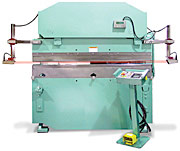
Press brake operators often hold the part close to the tooling, which makes press brakes hard to guard. Laser guarding that rides on the upper beam, and light curtains with programmable blanking and muting, protect the operator without stopping on every bend. PRI helps you pick the system for your machine and your parts.
View All Press Brake GuardingRequest a QuoteCall (800) 863-3164Why It’s Different · OSHA & ANSI · Methods · Systems · Choosing · What We Need · FAQs
Why Press Brakes Are Hard to Guard
On a press brake the operator often supports the workpiece by hand, close to the punch and die. A fixed guard, or a light curtain set at an ordinary safety distance, would get in the way of the work or stop the machine every time the part swings up during the bend. Press brake guarding watches the area right around the punch while the tools close at speed, and mutes only in the non-hazardous part of the cycle, so the operator is protected and the work keeps moving.
OSHA and ANSI for Press Brakes
OSHA’s mechanical power press standard does not apply to press brakes: 1910.217(a)(5) excludes them, along with hydraulic and pneumatic power presses. Press brakes fall under OSHA’s general machine guarding requirements, 1910.212, which require the point of operation of a machine that exposes an employee to injury to be guarded (1910.212(a)(3)(ii)). The consensus standard for press brakes is ANSI B11.3.
Press Brake Guarding Methods
PRI’s technical note, Press Brake Alternative Guarding Methods (in the downloads below), walks through the options.
Press Brake Guarding Systems From PRI

Buying a new press brake? PRI also sells Otinus hydraulic press brakes. Ask us to quote the guarding with the machine.
How to Choose Press Brake Guarding
- 1Identify the machineHydraulic, air-clutch or friction-clutch treadle operated; the CNC control and backgauge; bed length; and whether it has a slow (creep) bend speed.
- 2Know its stopping performanceLaser guarding relies on fast, consistent stopping. A light curtain’s safety distance comes from the measured stop time. PRI can measure it.
- 3Look at your partsShort parts held close to the tooling point to laser guarding or stroke stop. Box, tray and flanged parts need blanking, or a laser system that handles box profiles.
- 4Review the toolingStandard V tools, non-standard tools or multi-height tooling. Multi-height tooling may call for a light curtain as well as laser guarding.
- 5Plan the rest of the machineSide and rear guarding, emergency stops, and whether you need new motor controls or brake monitoring with the system.
Send what you have:
- Press brake make, model, tonnage and bed length
- Drive type (hydraulic, air clutch, friction-clutch treadle)
- CNC control and backgauge make
- Slow (creep) bend speed available?
- Typical parts: flat, box, tray or flanged, and size
- Tooling: V tools, non-standard or multi-height
- How often tools are changed
- Motor controls or brake monitoring needed
Press Brake Guarding Brands PRI Offers
Both are on our Additional Manufacturers line card. For new press brakes, see the Otinus line card.
Help From PRI
PRI’s application engineers will help you select a safety system that works for your press brake and your parts. PRI surveys press brakes against ANSI B11.3 and OSHA 1910.212, measures stop time, and supports installation and startup; on-site turnkey installations are available. See PRI services.
Press Brake Guarding Downloads
Frequently Asked Questions
What press brake guarding systems does PRI offer?
Production Resources, Inc. (PRI) offers two types of press brake guarding: LazerSafe laser guarding that mounts on the upper beam, and Protech Eagle Eye light curtains with control interfaces built for press brakes. PRI also supplies side and rear guarding.
How does LazerSafe press brake guarding work?
The LazerSafe transmitter and receiver are both mounted on the ram (upper beam). The laser field covers the area directly under and around the punch; it is muted when the brake goes into slow bend mode and stays muted until the top of the stroke.
Which press brakes can use Protech Eagle Eye guarding?
The Protech Eagle Eye light curtain and control interface system is custom configured for friction-clutch treadle operated press brakes, air-clutch machines and hydraulic press brakes. Its programmable beam blankout suits box or tray forming, where the part profile must interrupt the light curtain.
Does OSHA 1910.217 apply to press brakes?
No. 1910.217(a)(5) excludes press brakes. They fall under OSHA’s general machine guarding rule, 1910.212, which requires the point of operation to be guarded. The consensus standard for press brakes is ANSI B11.3.
Can LazerSafe be retrofitted to my press brake?
LazerSafe says Sentinel Plus can be retrofitted to most existing press brake models. It’s designed for hydraulic press brakes with a slow bend speed and fast stopping times. Send PRI the make, model and control and we’ll check it.
What is muting on a press brake?
Muting bypasses the guarding during the part of the cycle that isn’t hazardous. On LazerSafe systems the field is muted from the point where the brake goes into slow bend mode until the top of the stroke; Eagle Eye control interfaces mute the light curtain during the bending upstroke.
Related Guides
Press & Machine Safeguarding · Safety Light Curtains · Perimeter & Area Guarding · Clutch/Brake Controls · Safety Blocks
Send us the press brake details and the parts you bend. PRI will recommend the guarding and quote it.
View All Press Brake GuardingRequest a QuoteCall (800) 863-3164