


A die cart carries the die between the press, the die rack and the tool room, then pushes the new die onto the bolster and pulls the old one off. A cart dedicated to die changes ends the wait for a forklift or crane and makes every change the same.
Shop Die CartsRequest a QuoteCall (800) 863-3164How Carts Work · Types · Decks & Docking · Examples · Choosing · What We Need · FAQs
How a Die Cart Works
Die carts simplify die transportation, facilitate quick die change and improve safety. The deck is raised or lowered to the height of the bolster or rack shelf, the cart docks so it can't move during the transfer, and a push/pull mechanism slides the die across rollers or a low-friction deck onto the press. The old die comes off the same way.
Because the cart is dedicated to die changes, the next die can be brought to the press before the run ends instead of waiting for a forklift. Green Valley notes that a cart can travel the whole length of the plant, between the press, die storage and the maintenance area, while a die moved by crane is limited to the crane's reach. For how carts fit with racks, lifters and clamps in a full changeover, see the quick die change guide.
In the press, the die rides on die lifters or rollers in the bolster so it moves with little force. Those are covered in the die lifter guide.
Types of Die Carts


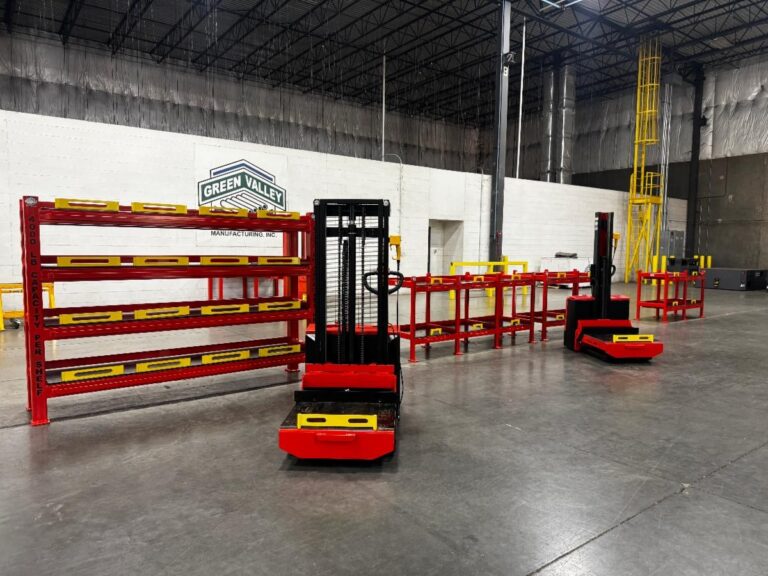

Decks, Push/Pull and Docking
Green Valley designs each cart for the customer's dies and plant. These options decide how the cart performs at the press:
Green Valley Die Cart Examples
Green Valley's die cart gallery runs from a 250 lb single station cart to a 120,000 lb cart. A few examples, including the models shown on this page before:
Green Valley Titan 163586 over/under die cart, 2 x 800 lb
How to Choose a Die Cart
- 1Heaviest die and footprintCapacity, deck size and push/pull stroke come from your heaviest and largest dies. Green Valley builds to the die, so send the whole range, not just the typical die.
- 2One die or twoA single station cart moves one die per trip. A double station or over/under cart brings the new die and takes the old one away in the same stop, which shortens the time the press is down.
- 3Route and useFree-ranging carts go anywhere; rail-mounted carts follow a fixed path and carry the heaviest dies. Measure the narrowest aisle, note ramps and floor joints, and count changes per shift, which sizes the battery.
- 4HeightsBolster height and rack shelf heights set the lift stroke. A variable-height deck serves presses and racks at different heights.
- 5Getting the die on and offPowered push/pull for heavier dies and repeatable changes, manual transfer for light ones. The press needs lifters or rollers for the die to ride on, and bolster extensions can bridge the gap to the bolster.
- 6Docking and controlsDecide how the cart locks to the press and the rack, and whether the operator walks with a tiller, rides along or uses a wireless pendant.
Send what you have. A die list and a floor plan go a long way:
- Die weights (heaviest and typical)
- Die length, width and shut height
- Bolster height and rack shelf heights
- Single or double station; end or side transfer
- Route from storage to the press, narrowest aisle and floor conditions
- Die changes per shift
- Sub-plates, and lifters or rollers in the bolster
- Free-ranging, rail-mounted or manual
- Hot dies, if any (deck surface)
Die Cart Brands PRI Offers


Help From PRI
PRI's Application Engineers start with your die list, presses and floor plan, help you choose the cart, deck, push/pull and docking that fit, and match the racks and press equipment to it. PRI coordinates installation and operator training with Green Valley and stays your contact for parts and service questions on the cart. See PRI services.
Frequently Asked Questions
What capacities are die carts available in?
Green Valley builds die carts to the die. Its gallery runs from a 250 lb single station cart to a 120,000 lb cart, and its rail-mounted carts carry loads over 100,000 lb. Manual, non-powered walk-behind carts are used for lighter tools, typically under 1,000 lb.
What is the difference between a free ranging and a rail mounted die cart?
Free ranging powered walk-behind carts can move anywhere in the press room and operate in confined spaces. Rail mounted carts run on in-floor rails, often between two presses or between the presses and die storage, and carry the heaviest dies.
How does a dual station die cart reduce changeover time?
It pre-stages the new die. The cart brings the new die to the press, pulls the old die onto its empty station and pushes the new die in, with no trip back to storage in between. The Green Valley Titan 1614, for example, carries two 3,000 lb dies in an over/under design.
What does the press need to work with a die cart?
The die needs something to ride on in the press: die lifters or rollers in the bolster slots, usually with a sub-plate under the lower die. Docking brackets or a floor rail hold the cart in place during the transfer.
Can a die cart work with my die storage racks?
Yes. Green Valley builds racks to match the cart deck height, with docking rails, interlock brackets and stops that release only when the cart docks. See the die storage rack guide.
Related Guides
Quick Die Change · Die Storage Racks & Tables · Die Lifters · Bolster Extensions · Die Clamps · Die & Mold Splitters
Send us your die weights, heights and floor layout. PRI will recommend the cart that fits and quote it.
Shop Die CartsRequest a QuoteCall (800) 863-3164