

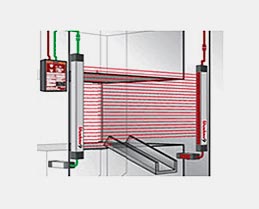
Safety light curtains are presence-sensing devices: a field of infrared beams across the opening to the die that stops the press when a hand breaks it, while leaving the operator full view of and access to the point of operation. PRI applies the Wintriss Shadow 10, built for the pressroom.
Shop Light CurtainsRequest a QuoteCall (800) 863-3164How They Work · OSHA Rules · Safety Distance · Installing · Shadow 10 · Choosing · What We Need · FAQs
How Safety Light Curtains Work
A transmitter and a receiver face each other across the opening to be guarded. When an object larger than the curtain’s object sensitivity (its resolution) breaks the beams, the curtain’s safety outputs open and the press control stops the slide. Light curtains protect primary operators, helpers and passersby, and they work on any part-revolution clutch power press, or hydraulic or pneumatic machine, that can be stopped anywhere in its stroke or cycle.
Safety light curtains are usually mounted vertically, from the bolster up, at the primary access to the point of operation. Often an additional set of optics guards the back of the machine, and mirrors can carry one field around the sides. Curtains for metal stamping should be control reliable and Category 4, and rugged enough to survive severe shock, die carts, lift trucks and stamping lubricants.
What OSHA Requires
Setting the Safety Distance
Light curtains must be mounted at a safe distance, set by OSHA and ANSI formulas that account for the stopping performance of the machine, a hand speed constant and other variables. OSHA’s formula is Ds = 63 inches/second × Ts, where Ds is the minimum safety distance in inches, 63 inches/second is the hand speed constant, and Ts is the stopping time of the press measured at about 90° of crankshaft rotation.
The ANSI formula is more conservative and is common practice today: Ds = K × (Ts + Tc + Tr + Tbm) + Dpf. K is the same 63 inches/second hand speed constant; Tc is the clutch/brake control response time; Tr is the light curtain response time; Tbm is the brake monitor allowance, the margin between the press’s actual stopping time and the brake monitor’s fault limit; and Dpf is the depth-penetration factor, set by the curtain’s object sensitivity. Blanking makes the effective object sensitivity larger, so it adds to the safety distance.
Stopping time changes as the brake wears, so measure it rather than taking it from the press nameplate. A brake monitor, or a clutch/brake control with one built in like the Wintriss WPC Apex, checks stopping performance on every stroke. PRI measures stop time on site and calculates the distance. You can also run the numbers with our safety distance calculator in the downloads below.
Installing Light Curtains Right
The Wintriss Shadow 10
The Shadow 10 is the current Wintriss safety light curtain, built specifically for metal stamping applications; Wintriss has more than 50,000 Shadow systems installed. It replaces earlier Shadow models. Up to four pairs of heads connect directly to a Wintriss WPC Apex clutch/brake control with no control box, or to the optional Shadow 10 control box, for up to 236" of protected zone on one control. That covers the front and back of a straight-side press plus walk-through protection on the operator side, with one control and one pair of cables.
| Shadow 10 | |
|---|---|
| Protective height | 11.8" (300 mm) to 59" (1500 mm) |
| Object sensitivity | 22 mm, for hand protection |
| Maximum range | 26 ft (8 m) |
| Heads | Rugged extruded heads, only 1.5" x 1.5"; universal brackets and shock mounts included with the heads and mirrors |
| Heads per control | Up to 4 pairs on a WPC Apex or the optional control box; up to 236" of protected zone |
| Safety | Category 4; 2 cross-checked PNP safety outputs; CSA, UL and TÜV approvals |
| Blanking | Self-learning programmable fixed blanking (one beam stays unblanked at the top of each receiver); floating mode up to 3 beams wide for single or multiple small objects |
| Diagnostics | Numeric diagnostic code display, individual beam indicators, LEDs that show the blanked area |
| Optional control box | Two cross-checked solid-state outputs, 24 VDC supply for the heads, key switch for supervisory control of blanking, optional dry-contact module for a beacon or alarm |
From Wintriss’s Shadow 10 product page. Confirm current ratings with PRI when you quote.
Running an earlier Wintriss light curtain? PRI supports installed Wintriss systems where it can, and can help you plan the move to Shadow 10.
Light Curtains From PRI

How to Choose a Light Curtain
- 1Confirm the press can use oneA part-revolution clutch, a control-reliable clutch/brake control and a working brake monitor. If the press doesn’t have them, start with the control.
- 2Measure stopping timeMeasure at about 90° of crank rotation and calculate the safety distance with the OSHA or ANSI formula.
- 3Pick the object sensitivityA finer resolution means a smaller depth-penetration factor and a shorter safety distance. The Shadow 10 is 22 mm, for hand protection.
- 4Size the protected heightCover the opening so no one can reach over or under the field, allowing for bolster height, platforms and operator height.
- 5Count the sidesFront, rear, sides and walk-through protection. Plan the heads, mirrors and how many pairs one control can run.
- 6Plan blanking and mutingList anything that must stay in or pass through the field (feeds, conveyors, chutes, hoses) and whether you need upstroke muting.
- 7Plan the interfaceConnect straight to a WPC Apex, or use a control box with relay outputs for a relay-based press control.
Photos of the press from the operator side help most:
- Press make, model, type and tonnage
- Clutch type and current clutch/brake control
- Stopping time, if measured recently
- Opening to guard: width, height and bolster height
- Sides to guard (front, rear, sides, walk-through)
- Objects in the field: feeds, conveyors, chutes, hoses
- Hand-fed or automatic; single stroke or continuous
- How the curtain will connect (WPC Apex, relay control, PLC)
Light Curtain Brands PRI Offers


Press brake light curtains: Protech Eagle Eye, on our Additional Manufacturers line card.
Help From PRI
Applying a safety light curtain takes a thorough understanding of the safety regulations, and PRI’s application engineers and Wintriss technical support keep up with the changes. At your request we will check your application and recommend the right light curtain configuration and any supplemental guarding it needs, measure stop time and calculate the safety distance, and support installation and startup. PRI also does OSHA compliance surveys of power presses; see PRI services.
Light Curtain Downloads
Frequently Asked Questions
What is a safety light curtain?
A presence-sensing device that can be used as point-of-operation safeguarding. A transmitter and receiver create a field of infrared beams across the opening to the die; when a hand or other object breaks the field, the press control stops the slide. Operators keep full view of and access to the point of operation.
How far from the point of operation must a light curtain be mounted?
At least the safety distance. OSHA’s formula is Ds = 63 inches/second × Ts, where Ts is the press stopping time at about 90° of crank rotation (1910.217(c)(3)(iii)(e)). The ANSI formula adds the control and light curtain response times, a brake monitor allowance and a depth-penetration factor based on the curtain’s object sensitivity.
Can light curtains be used on full-revolution clutch presses?
No. OSHA 1910.217(c)(3)(iii)(a) says a presence-sensing device may not be used on machines using full-revolution clutches. Light curtains work on part-revolution clutch presses and hydraulic or pneumatic machines that can be stopped anywhere in the stroke.
What is a walk-through hazard?
When the safety distance is large, a person can stand between the light curtain and the die, out of the field. An additional horizontal curtain or another set of optics covers that space. The Shadow 10 can run up to four pairs of heads from one control for front, rear and walk-through protection.
What is blanking?
Blanking turns off part of the light curtain so an object can be in the field. Fixed blanking lets a stationary object such as a conveyor stay in the field; floating blanking lets small objects move through it. Blanking increases the safety distance and should be under supervisory control.
How many light curtains can connect to one Wintriss control?
Up to four pairs of Shadow 10 heads connect directly to a WPC Apex clutch/brake control or to the optional Shadow 10 control box, for up to 236 inches of protected zone.
Does PRI support older Shadow light curtains?
Earlier Shadow models have been replaced by the Shadow 10. PRI supports installed Wintriss systems where it can and can help you plan a replacement.
Related Guides
Press & Machine Safeguarding · Clutch/Brake Controls · Perimeter & Area Guarding · Press Brake Guarding · Die Doors · Safety Blocks
Send us the press, the control and the opening to guard. PRI will recommend the light curtain setup, calculate the safety distance and quote it.
Shop Light CurtainsRequest a QuoteCall (800) 863-3164