

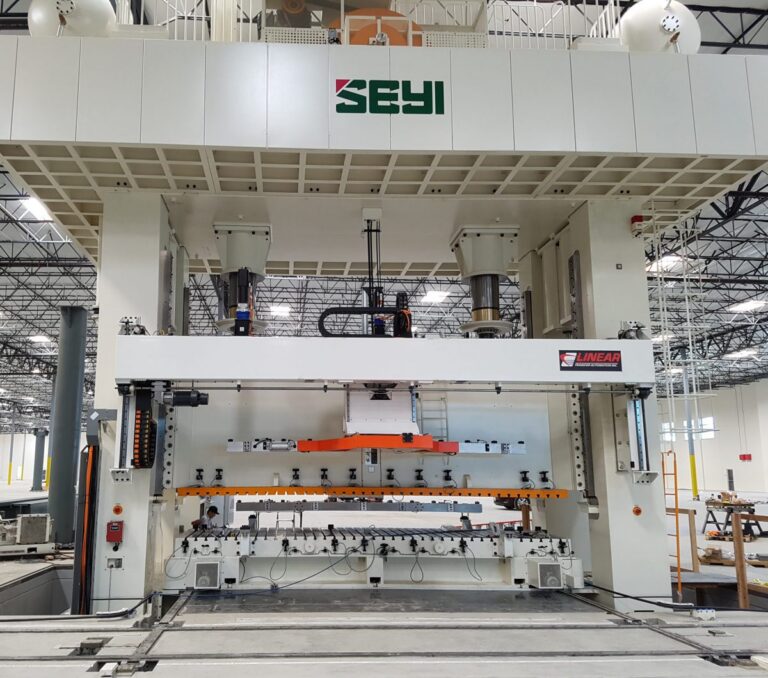
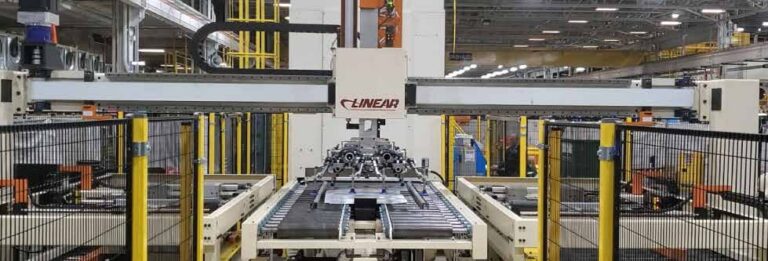
A press transfer system carries each part from station to station in a transfer die with fingers on servo-driven bars, instead of a carrier strip. Production Resources, Inc. (PRI) supplies the whole package: Linear servo transfers and destackers, Norgren transfer tooling and Bachhuber press unloaders, with help choosing what fits your press.
Shop Press Transfer AutomationRequest a QuoteCall (800) 863-3164Transfer vs. Progressive · The Equipment · Transfer Types · Choosing · What We Need · Brands · FAQs
Transfer vs. Progressive Tooling
Transfer is an increasingly popular alternative to progressive tooling because of the potential material savings. In a progressive die, the part stays attached to a carrier strip until the last station. In a transfer die, parts are carried from station to station with transfer bars and fingers, which eliminates the carrier strip and skeleton material that a progressive die needs.
Blanks are fed to the first station of the transfer die. From there the servo control moves the bars through each part's pitch, lift and, if required, rotation, so the motion is set for each job and stored with it. Because the part is free of the strip, a transfer die can also handle larger and more complex parts.
The Equipment in a Transfer Line
A transfer line has four jobs: load blanks, move the part through the die, hold the part while it moves, and unload the finished part. Pick a card to read the guide, or go straight to the catalog.
Types of Transfer Systems
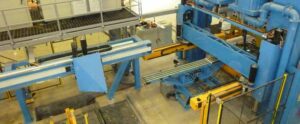
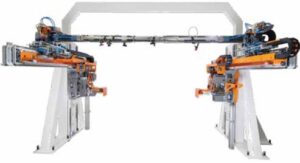
How the transfer mounts depends mostly on the press window, the bolster size and the payload. Linear builds each type:
Stamtec presses can be built with the transfer system you choose, including Linear, and Stamtec builds transfer presses for dies that are very large left to right and front to back. See power presses. For coil-fed versus blank-fed transfer lines, see feeding a transfer press.
How to Choose a Transfer System
- 1Decide transfer or progressiveCompare material use, part size and shape, and volumes. A transfer die saves the carrier strip and skeleton; a progressive die keeps every station on the strip.
- 2Check the pressPress type and tonnage, bolster size, window size, sound doors, stroke and strokes per minute. These decide front-and-rear, window or bolster mounting.
- 3Count the stationsNumber of die stations, the pitch between them, the lift needed to clear the die, and any rotation between stations.
- 4Plan the toolingFingers, grippers, shovels or vacuum cups; how they change over between jobs (receivers and tool changers); and part-present sensing. See the transfer tooling guide.
- 5Plan the feed in and outCoil-fed, or blank-fed with a destacker and double blank detection at the front; an exit conveyor, racking or stacking at the end.
- 6Simulate before the die is builtLinear runs a 3D transfer simulation and run rate analysis and works directly with your die shop, which shortens startup.
- 7Tie in controls and die protectionTransfer recipes by job, part-in-place sensors, and press automation such as Wintriss SmartPAC PRO. See die protection and press automation.
Send what you have. A die drawing and the press specs answer most of it:
- Press make, model, tonnage and bolster size
- Press window size, and any sound doors
- Stroke length and target strokes per minute
- Part drawings, weights and material
- Number of die stations and pitch
- Lift and rotation needed between stations
- Coil or blank fed; blank size
- How finished parts leave the press
- New press or retrofit; will the press also run progressive dies?
Transfer Brands PRI Offers



Also through PRI: Bachhuber press unloaders, blank feeders and stackers, on our Additional Manufacturers line card.
Help From PRI
PRI's Application Engineers start with your part, your die and your press, then bring in Linear's engineers, Norgren tooling and your die shop so the transfer, the tooling and the die are planned together. PRI supports installation and startup, operator training and parts. A transfer changes how the press is guarded, so PRI's safety surveys and stop-time measurements help you place light curtains and guards around it. See PRI services and the safeguarding guide.
Transfer Downloads
Linear's brochure covers every transfer series. For launching a new transfer job, read Keys to Success When Launching a Transfer Job by Paul Stirrett of Linear.
Frequently Asked Questions
What is a press transfer system?
A system that moves parts from station to station in a transfer die. Transfer bars with fingers, grippers or vacuum cups pick up the part, move it one pitch, set it down and return, with every axis under servo control on a Linear transfer.
Why use a transfer die instead of a progressive die?
Mainly material savings: the part isn't carried on a strip, so there is no carrier strip or skeleton to scrap. A free part also allows larger and more complex shapes. A progressive die keeps everything on the strip and needs no transfer.
Can a transfer be added to an existing press?
Yes. Linear's FR series mounts on the front and rear of presses with small or no windows, the WM series mounts through larger windows, and bolster-mounted transfers fit compact presses.
What is the difference between a transfer and press-to-press automation?
A transfer moves the part between stations of a die inside one press. Press-to-press automation, tandem lines and crossbar transfers move the part from one press to the next in a line.
What is double blank detection?
A sensor at the front of the line that catches two blanks stuck together before they go into the die, so the line can reject them. Norgren double blank analyzers and Linear front-of-line systems include it. See also double sheet detection.
What are transfer fingers?
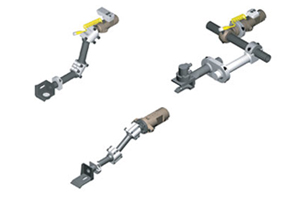
The tooling on the transfer bars that holds the part: a receiver on the bar, a finger built from tubing and clamps, and an end effector such as a gripper, shovel or vacuum cup. The Norgren transfer tooling guide covers them.
Related Guides
Linear Automation · Norgren Transfer Tooling · Bachhuber Press Unloaders · Assembly Automation · Die Protection & Press Automation · Cut-to-Length & Transfer Press Feed Lines · Power Presses · Press Safeguarding
Send us the press, the die and the part. PRI will recommend the transfer, tooling and feed equipment that fit, and quote the system.
Shop Press Transfer AutomationRequest a QuoteCall (800) 863-3164