


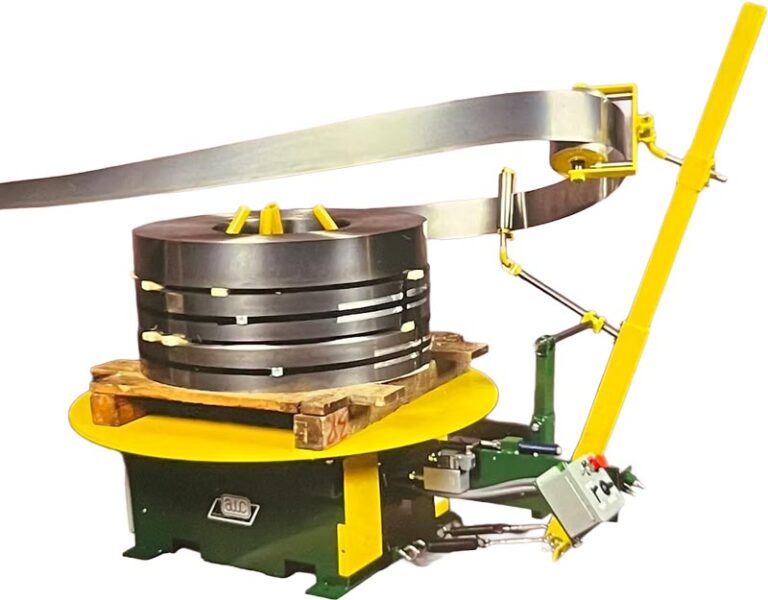
Everything between the coil and the die: reels and decoilers to pay off the coil, straighteners to take out coil set, and air or servo feeds to index the strip into the press, plus complete lines and cut-to-length. PRI helps you size the line and supplies it.
Shop Coil & Feed ProductsRequest a QuoteCall (800) 863-3164How a Line Works · Line Layouts · The Equipment · Sizing a Line · What We Need · Brands · FAQs
How a Coil Feed Line Works
PRI offers a wide variety of coil handling, feeding and cut-to-length equipment to uncoil, straighten, feed and shear metal, paper or plastic coiled material, and helps you select the right equipment to deliver coil stock to power presses, shears or similar equipment.
A typical line runs in this order. A reel, pallet decoiler or cradle pays off the coil. A straightener takes out coil set. A loop between the payoff and the feed lets the coil run steadily while the feed indexes, and a loop control starts and stops the payoff or straightener to keep that loop in range. The feed then advances the strip into the die by the programmed length every stroke.
The right coil handling and feeding equipment adds flexibility to your coil processing, reduces setup time, improves quality, reduces scrap and saves floor space. Whether you need a simple die- or press-mounted air feed or a complete coil handling and feeding line, PRI's Application Engineers will help you select and implement the right equipment for the job.
Coil Line Layouts
The Equipment
Pick a card to read the guide for that equipment, or go straight to the catalog.




Upgrading an Existing Feed
If your tool changes have become more frequent and quick, accurate, repeatable feeding matters more, PRI can replace worn or unreliable air feeds, hitch feeds or crank-driven roll feeds with a servo feed. A servo feed lets you change feed lengths in seconds, feed accurately, eliminate die breakage from misfeeds and feed at faster press speeds. PRI also offers drive and control upgrades for older servo feeds, and feeding and coil handling equipment can be integrated with new or existing press automation controls.
How to Size a Coil Line
- 1Start with the materialMaterial type, tensile and yield strength, and the width and thickness range set the straightener and feed size. Straightening ranges are usually rated on low-carbon steel, so tell us about higher-strength or thin, high-strength material.
- 2Coil size and weightCoil ID, OD, width and weight set the reel, decoiler or cradle. If coils run out quickly at your feed length and press rate, a double-ended reel or another way to stage the next coil keeps the press running.
- 3Feed length and speedThe shortest and longest feeds at their strokes per minute (for example, 6" at 120 SPM and 24" at 40 SPM) decide air versus servo feed and the drive sizes.
- 4Accuracy, pilots and timingHow accurate the feed must be, whether the die uses pilots and needs pilot release, and what will time the feed (a programmable limit switch or press automation control).
- 5Floor space and layoutCompact combinations and close-coupled lines fit where a conventional line with a full loop won't. Note whether a pit is possible.
- 6Passline and mountingMinimum and maximum material passline, how often it changes, and whether the feed mounts to the press or on a cabinet.
- 7Extras that cut setupMotorized passline and straightening rolls, automatic coil centering, a crop shear for clean ends and rewinds, and an interface to press automation such as Wintriss SmartPAC PRO.
Send what you have, or download our application note below:
- Material type, tensile and yield strength
- Minimum and maximum width and thickness
- Coil ID, OD and weight
- Feed lengths and strokes per minute
- Feed accuracy needed; pilots and pilot release
- Press make, model and passline range
- Floor space, and whether a pit is possible
- How coils arrive and are loaded (coil car, upender, crane)
- Finish concerns (marking), cleaning or oiling needs
- Preferred controls (Allen-Bradley, Siemens, etc.)
Strip Lubrication
Coil Handling Brands PRI Offers


Also through PRI: Accra-Wire pallet decoilers, Caldwell coil hooks and upenders, and Coiltek ultrasonic loop controls. See Additional Manufacturers.
Coil Handling Downloads
Frequently Asked Questions
What equipment is in a coil feed line?
A payoff (reel, pallet decoiler or cradle), a straightener to remove coil set, a loop with a loop control, and a feed that indexes the strip into the die. Cut-to-length lines add a shear, and many lines add a stock cutter or scrap chopper after the press.
Should I use an air feed or a servo feed?
Air feeds are simple and economical for lighter stock and shorter feeds; Rapid-Air standard air feeds take stock up to 16" wide and .150" thick with strokes to 20". Servo feeds set the feed length at the control so it can be changed in seconds, and they cover longer feeds and wider, heavier stock.
Do I need a straightener?
If coil set (the curve left from coiling) causes feeding or flatness problems, yes. A straightener removes it before the strip reaches the feed. Pull-through straighteners are pulled by the feed; powered straighteners drive the strip themselves.
What information do you need to quote a coil line?
Material type and yield strength, width and thickness range, coil ID, OD and weight, feed lengths and strokes per minute, accuracy and pilot needs, the press and passline, and the floor space you have. Our application note lists every question.
Can PRI upgrade an existing feed?
Yes. PRI can replace worn air, hitch or crank-driven roll feeds with a servo feed, and offers drive and control upgrades for older servo feeds.
Related Guides
Air Feeds · Servo Feeds · Coil Reels · Straighteners · Pallet Decoilers · Cut-to-Length · Scrap Choppers · Power Presses · Quick Die Change
Send us your material, coil and feed requirements. PRI will recommend the payoff, straightener and feed that fit, and quote the line.
Shop Coil & Feed ProductsRequest a QuoteCall (800) 863-3164